

News/All pieces
by NK (comments: 0)
Paludiculture for the planet!
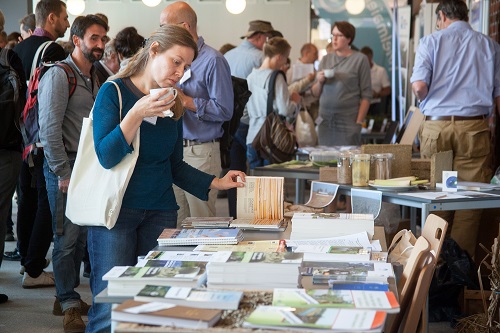
Conference week RRR2017started
27/09/2017 There is power in peatlands! At the International Paludiculture Conference RRR2017 - Renewable resources from wet and rewetted peatlands 27th-29th September in Greifswald scientists, practitioners and politicians discuss how to tap their potential for climate protection, alternative agriculture and saving great socio-economic costs. Text: Wet peatlands protect the world’s climate as gigantic carbon sinks. Drained peatlands, in contrast, globally emit over 2 Gt of carbon dioxide per year. To reverse this dramatic climate damage peatlands must be rewetted and can often still be cultivated. Paludiculture – the utilization of wet peatlands – can chant the spell and deliver renewable energy resources and biomass for building material or fodder while substituting fossil resources. Apart from this, wet peatlands offer ecosystem services such as nutrient removal, water retention and habitat provision. Almost 200 scientists, land owners, land users and environmentalists assemble at the RRR2017 to promote this promising and necessary concept.
by NK (comments: 0)
RUMOOREN! - art meets peatlands
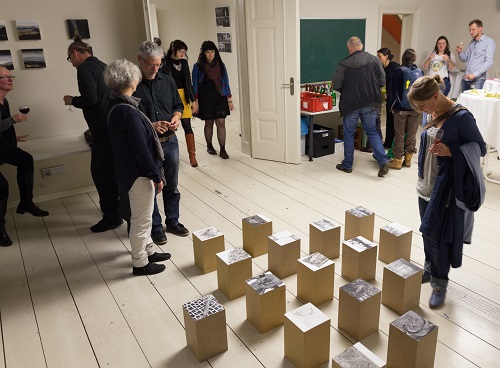
Turf sculptures and typha cushions - visit till 8th October at CDFI
22/09/2017 The art exhibition RUMOOREN! offers unusual perspectives on peatlands. Organised by the Greifswald Mire Centre in cooperation with the Caspar-David-Friedrich-Institute of Greifswald University, exhibits by 19 artists are presented, e.g. turf installations and typha cushions. The art pieces are intended to promote wider public perception of peatlands, climate protection and sustainable use. The use of peat in art is critically reflected.
About one hundred art and peatland lovers attended the vernissage on 24th September. RUMOOREN! is part of the international paludiculture conference week Renewable resources from wet and rewetted peatlands 2017. The exhibition is open 25th-28th September 8 am – 8 pm and 29th September – 8th October 12 am - 6 pm at the Caspar-David-Friedrich-Institute (Bahnhofstraße 46/47, Greifswald). The entrance is free.
by NK (comments: 0)
Countdown for RRR2017
International week on paludiculture
07/09/2017 : Less than one month to go until the international paludiculture conference week RRR2017 from 25th - 30th September 2017 organised by the Greifswald Mire Centre starts. It offers a national and an international conference, a day of excursions and a Sphagnum farming workshop. The GMC is happy to welcome Prof. Ab Grootjans, Prof. Hans Joosten and Faizal Parish as key note speakers.
Besides the extensive scientific programme there is an amazing range of interesting related events: A show of machinery and technical equipment for agriculture of wet peatlands will occupy the entire market square in the heart of Greifswald on Wednesday 27th . Take the chance for a close look at e.g. modified snowcats or balloon tired reed harvesters! Stroll around in the ‘paludarium’ at the Botanical Garden of Greifswald University (Münterstraße 2, Greifswald) to see an exhibition of potential paludiculture plants and find more than 40 exhibition describing their use. See peatlands in new perspective and visit "RUMOOREN - Kunst trifft Moor" - an art exhibition initiated by the GMC in cooperation with the Caspar-David-Friedrich-Institute of Greifswald University. “RUMOOREN!” shows contributions by 20 artists aiming for public awareness and social exchange to gain more acceptance and understanding for peatland protection. Join a musical, literary journey “Between worlds in the wafts of mires” or an evening with nature conservationist Michael Succow. The biologist and laureate of the “Right Livelihood Award” takes you on a journey from bogs of Northwestern Germany via mires of the Southern Baltic Sea area up to the central German uplands and the Alps.
by NK (comments: 0)
Big milestone for peatland restoration achieved
VCS methodology for rewetting of drained temperate peatlands online
05/08/2017 The Verified Carbon Standard (VCS) is the world’s leading voluntary programme for the certification of greenhouse gas emission reduction projects. The methodology outlines procedures to estimate the reduction of net greenhouse gas emissions resulting from project activities implemented to rewet drained peatlands in temperate climatic regions. It uses ground vegetation composition and water table depth as proxies for peatland greenhouse gas emissions, known as the ‘GEST’ approach (GEST: Greenhouse gas Emission Site Type), which has been developed at the Greifswald Mire Centre. The development of this methodology was funded by the Federal Ministry for the Environment, Nature Conservation, Building and Nuclear Safety (BMUB) within a peatland restoration project of the International Climate Initiative, the University of Greifswald, Partner in the Greifswald Mire Centre, and Silvestrum Climate Associates. Authors of the methodology are Dr. Igino Emmer (Silvestrum Climate Associates) and John Couwenberg (Greifswald University, Partner in the Greifswald Mire Centre).
by NK (comments: 0)
A new push for Aquatic Warbler Conservation

Salvation of the globally threatened mire bird not yet given up
13/07/2017 The beginning of July could symbolically be called a new begin for aquatic warbler conservation. Experts from six countries met in Zuvintas (Lithuania) to discuss practicalities of a new method for aquatic warbler conservation - translocation. As Martin Flade, the Chairman of International Aquatic Warbler Conservation Team (AWCT), pointed out, there is much more good-quality habitat than area occupied by the bird. In some areas the population is so small that it could not recover itself naturally. During a currently running LIFE project , it is planned to transfer aquatic warbler juveniles from Belarus to Lithuania. According to Zymantas Morkvenas, director of Baltic Environmental Forum Lithuania and project manager of the LIFE project, the main goal is to test the technique that later on could help to save other small populations in other countries. The Scientific Advisory Board includes representatives of International Aquatic Warbler Conservation Team (AWCT), Royal Society for the Protection of Birds (RSPB), University of Cambridge, Polish Society for the Protection of Birds (OTOP), Greifswald Mire Centre (GMC), "Earthmind", Ministry of Environment of the Republic of Lithuania, Zuvintas Biosphere Reserve Directorate, and Baltic Environmental Forum Lithuania. The current status and perspectives for conservation of the small Pomeranian population will be discussed at a Polish-German meeting 21.07.2017 in Criewen.
by NK (comments: 0)
Kick-off for CLEARANCE
Estimating values of wetland buffer zones
12/07/2017 Evaluating costs and benefits of Wetland Buffer Zones including market and non-market values is one task of the recently started interdisciplinary EU project CLEARANCE. Wetland buffer zones are wetlands located between the agricultural land and aquatic ecosystems, capturing nutrient-rich runoff water before it reaches rivers and lakes to reduce nutrient loads in surface waters at water-land interface. Consortium partners are, together with Greifswald University, Kiel University, two universities in Warsaw (Poland), Aarhus University (Denmark), Nijmegen University (the Netherlands) as well as the Leibniz-Institute of Freshwater Ecology and Inland Fisheries (IGB) Berlin as well as a German and a Polish NGO. From 2017 until 2020 scientists will assess values related to recreation, biodiversity, nutrient removal, biomass utilisation, etc. on catchments in Denmark, Germany, the Netherlands and Poland. CLEARANCE will deliver knowledge on multifunctional wetland buffer zones and raise awareness in all partner countries.
by NK (comments: 0)
Peatlands matter!
Focus on peatlands at Global Landscape Forum
19/05/2017 The Global Landscape Forum at 18th May was fully dedicated to peatlands! With the slogan “Peatlands matter!” the event aimed to bring together local and global policymakers, stakeholders and private sector interests in order to identify landscape-level solutions. It also intended to accelerate measurable action on the ground in negotiating conflicting land use demands in these vital ecosystems.
The international audience discussed ways of peatland conservation, restoration and sustainable use in paludiculture. The event had 425 people attending in Jakarta as well as over 1,000 views of the event livestream and 5,000,000 people reached through Twitter. Peatlands matter and they must be wet!
by NK (comments: 0)
Brand new and all about Europe’s peatlands
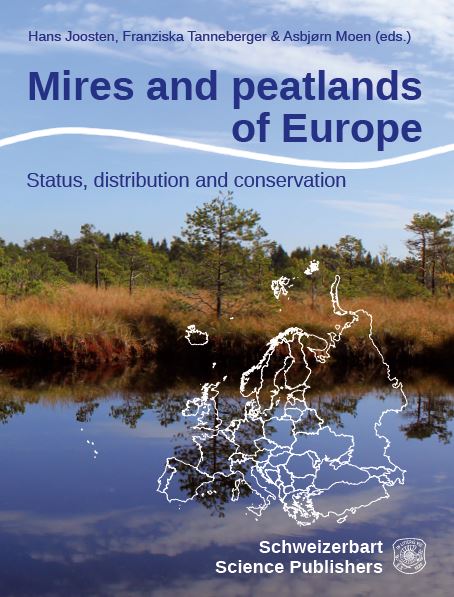
New book of the Greifswald Mire Centre
10/05/2017 After more than 25 years of preparation, the long expected book Mires and peatlands of Europe is now available. This book provides – for the first time in history – a comprehensive and up-to-date overview of mires and peatlands in biogeographic Europe. Written by 134 authors, the book describes mire and peatland types, terms, extent, distribution, use, conservation, and restoration individually for each country and integrated for the entire continent. Complemented by a multitude of maps and photographs, the book offers an impressive and colourful journey, full of surprising historical context and fascinating details, while appreciating the core principles and unifying concepts of mire science. The publication of this book was coordinated for the International Mire Conservation Group by the Greifswald Mire Centre. The publication was co-sponsored by the Norwegian University of Science and Technology (NTNU), University Museum, Trondheim, Norway.
by NK (comments: 0)
Global Peatland Initiative at Climate Conference
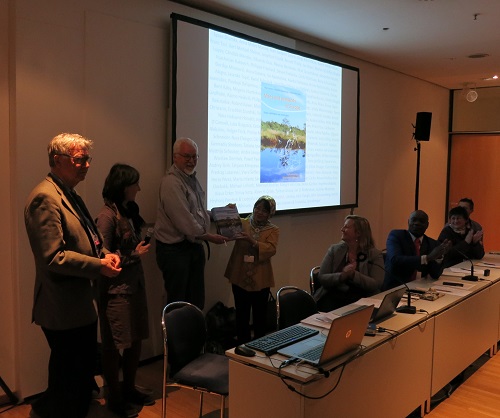
Side event at 9th May in Bonn
09/05/2017 The book Mires and peatlands of Europe came hot off the press when it was launched at the side event of the Global Peatland Initiative (GPI) at the Climate Change Conference in Bonn 9th May 2017. The side event provided an opportunity for governments, institutions, stakeholders and partners to exchange on advancing efforts to protect peatlands and was jointly organised by UN Environment, FAO, the Ramsar Convention, Wetlands International and GMC. The three editors of the book - Hans Joosten, Franziska Tanneberger (both GMC) and Asbjørn Moen - handed over the first copy of the book to Nur Masripatin, Director General for Climate Change for the Ministry of Environment and Forestry of Indonesia, highlighting major lessons from Europe how to deal wisely with peatlands to avoid further degradation. This feeds perfectly into the vision of enhanced south-south-north exchange under the GPI, discussed during an interactive panel discussion chaired by Hans Joosten. Especially ‘newcomers’ in the peatland community like panel member Joseph Badevokila, national focal point to the UNFCCC of the Republic of Congo, were delighted by the vast experience and knowledge among the partners of the GPI. The side event paved the way to the upcoming negotiations in the land use sector under the UNFCCC and the upcoming Global Landscape Forum: Peatlands matter in Jakarta on 18th May.
by NK (comments: 0)
World Migratory Bird Day
Greifswald Mire Centre offering excursion
05/04/2017 2017 Just outside of Greifswald the Karrendorfer Wiesen provide a splendid location for bird watching at World Migratoy Bird Day! The Greifswald Mire Centre is inviting birdlovers on a guided tour to see long-distance migrants such as the sedge and the reed warbler, wheatears, redshanks and avocet. Back from their wintering grounds in sub-Sahara Africa they breed there in reeds, on the salt meadows and the shore area. Waders such as wood sandsnipers and dunlins might also be spotted on their way further North. Apart from that there are skylarks and greylag goose. The salt meadows of Karrendorfer Wiesen do not ony present a rare breeding habitat for migratory birds. After its restoration this coastal flood peatland serves as wave breaker. Its vegetation slows erosion of the shore zone and promotes sedimentation. Thus it contributes to the stability of the flat coasts of the Baltic Sea. After flooding, natural waterways ensure rapid drainage. In addition, coastal flood peatlands are significant carbon sinks and therefore important for climate protection.