

News/All pieces
by Berit Krondorf (comments: 0)
Save the Date: Paludiculture Conference
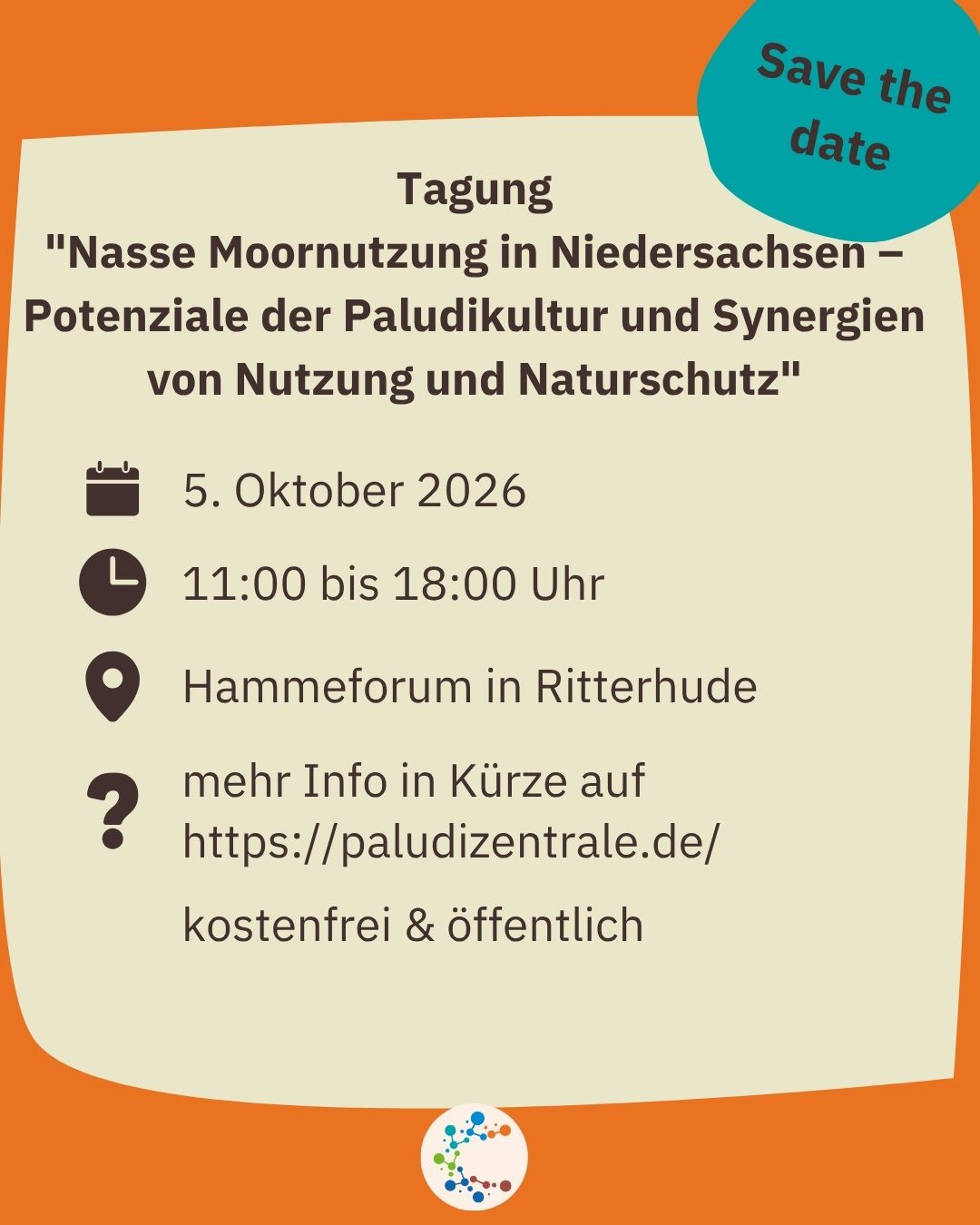
Focus on peatland use in Lower Saxony
by Berit Krondorf (comments: 0)
New policy briefs published
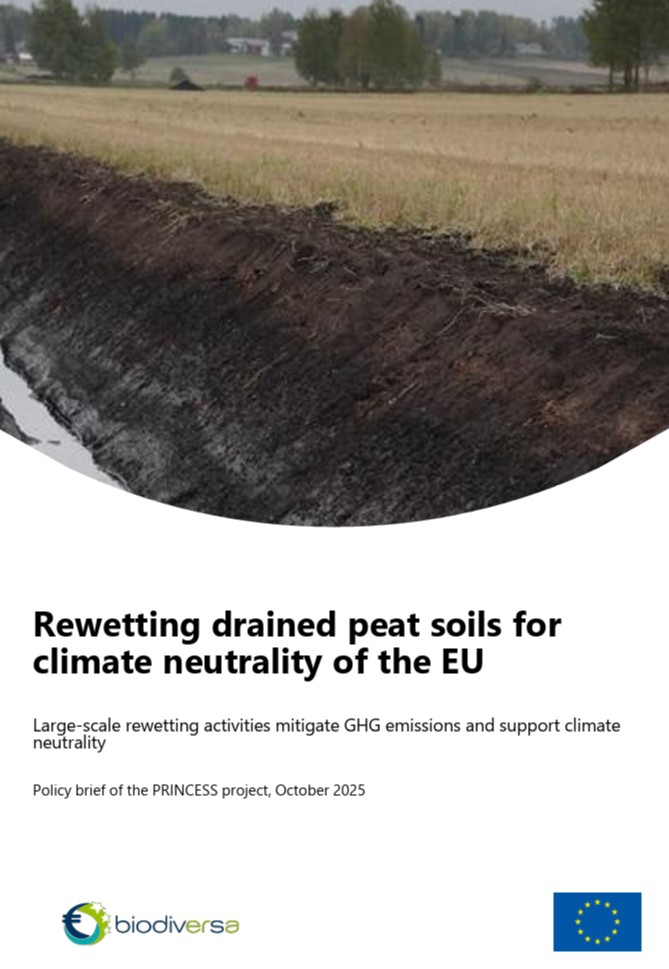
Peatland rewetting for climate neutrality
18/05/2026 The Greifswald Moor Centrum has published a new series of policy briefs. Titled “2026 Policy Briefs: Rewetting drained peat soils supports climate neutrality”, the publications highlight how rewetting drained peat soils can significantly reduce greenhouse gas emissions and support national and European pathways towards climate neutrality.
The series includes an EU-level edition as well as country-specific versions for Germany, Belgium, Finland, Austria, and Poland. The policy briefs provide science-based and practice-oriented insights for policy and decision-making, illustrating how peatland rewetting as a nature-based climate solution can contribute to achieving climate goals.
The publications are aimed at policymakers, administrations, and practitioners and offer context-specific information tailored to different national settings.
Further information and access to the policy briefs are available online: GMC briefing papers
by Berit Krondorf (comments: 0)
Paludiculture – how does it work?
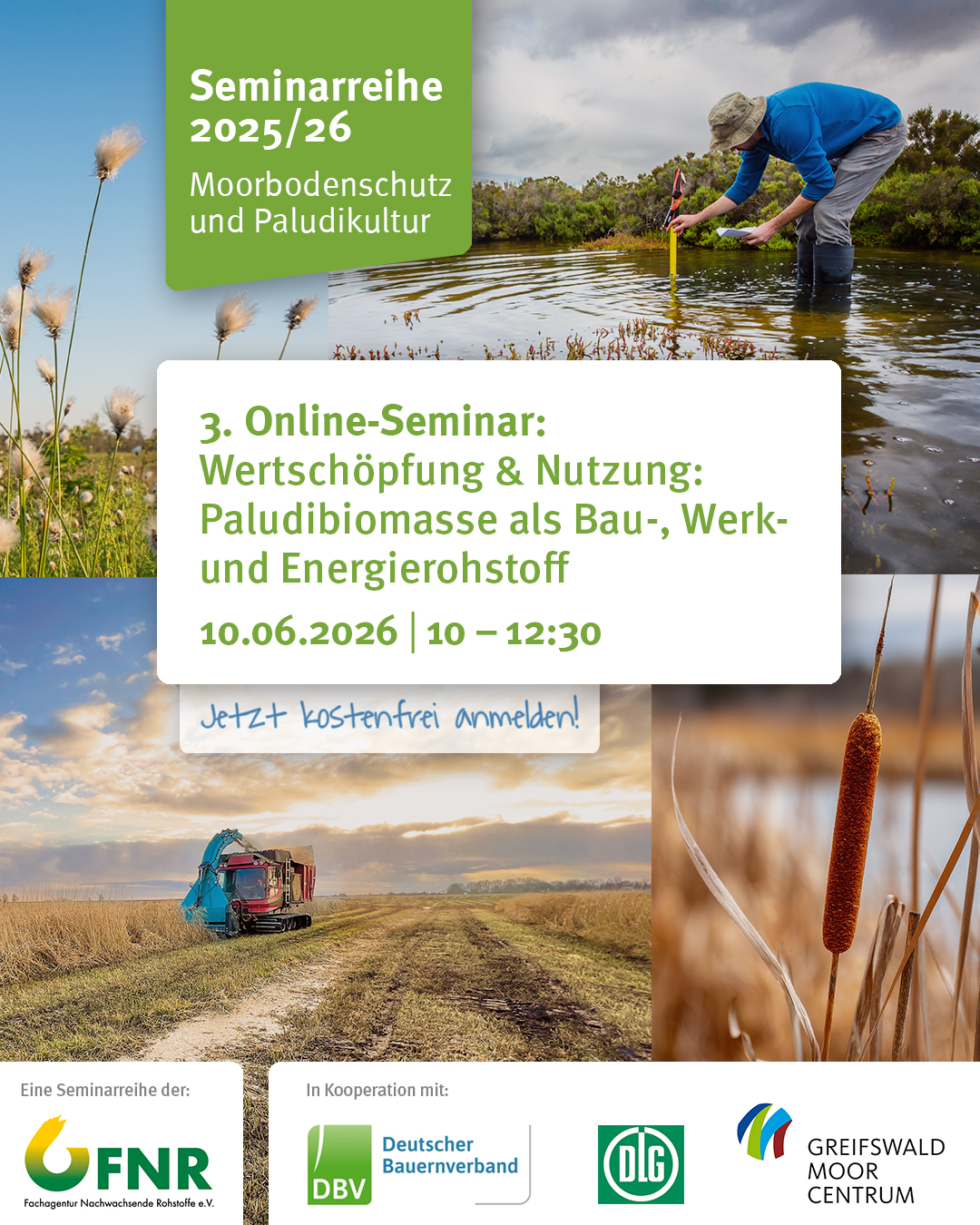
Online seminar on value creation
13/05/2026 How can paludibiomass be used as a raw material for construction, manufacturing and energy? This question will be addressed in the free online seminar ‘Value Creation & Utilisation: Peatland Biomass as a Raw Material for Construction, Industry and Energy’ on 10 June 2026 from 10:00 to 12:30.
The seminar will focus on material and energy applications of peatland crops, market potential and practical examples along the value chain. The event is aimed at stakeholders from agriculture, business, science and public administration.
The programme includes presentations by Roman Adam on the link between peatland climate protection and value creation through MoorFaser, by Henning Voigt on cattail as a peatland crop, and by Frank Havemeyer on the development of regional value creation structures using peatland biomass in the Teufelsmoor.
The seminar series, jointly organised by FNR, the Farmers’ Association and the Greifswald Moor Centrum, is designed to be interactive and offers opportunities for exchange and discussion, as well as new perspectives on the sustainable use of peatland soils.
by Berit Krondorf (comments: 0)
Open Call: Join the Innovation!
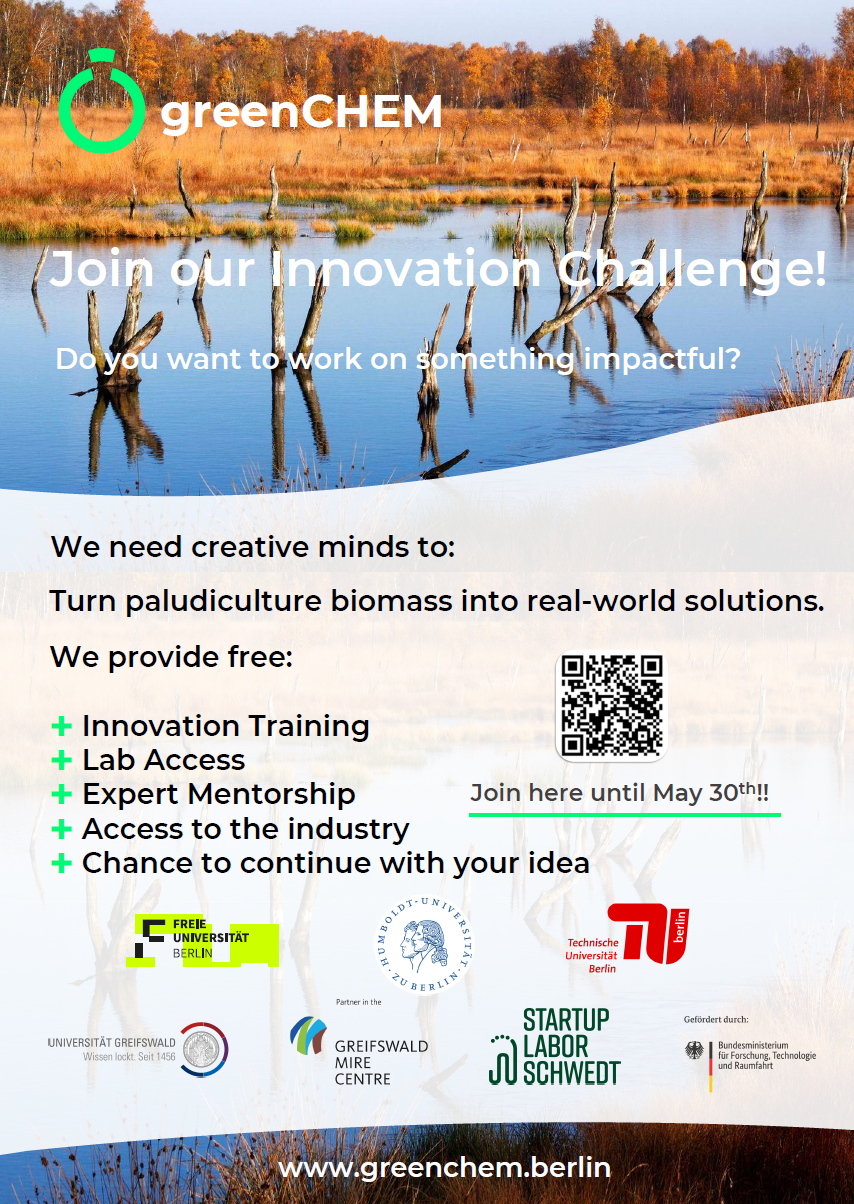
Ideas for paludi biomass wanted.
11/05/2026 Researchers, students, and early-stage teams are invited to apply for the new “greenCHEM x Paludi Challenge”. The innovation program supports the development of new applications and value chains for underutilized paludi biomass and its side streams.
The challenge is looking for ideas for sustainable materials, chemical building blocks, or scalable processes that can contribute to climate-positive land-use approaches.
Participants will gain access to laboratories, infrastructure, equipment, and biomass, alongside workshops, mentoring from academia and industry, and opportunities to test and validate ideas in practice. The program also offers networking opportunities within a strong innovation ecosystem and support for further validation projects or funding opportunities.
Applications are now open. The application deadline is 30 May 2026.
The initiative involves besides the Greifswald Mire Centre also the Universität Greifswald, Technische Universität Berlin, Humboldt-Universität zu Berlin, Freie Universität Berlin and additional partners.
Further information and application details are available online.
by Berit Krondorf (comments: 0)
Spin the big wheel of peatland knowledge
at Science Day 2026 in Greifswald
08/05/2026 At Science Day 2026 on 27 June 2026, peatland researchers from the University of Greifswald and the Greifswald Mire Centre will be spinning the wheel – the wheel of peatland knowledge – offering insights into their work on peatlands and climate protection. At an own stand, they will demonstrate the role peatlands play for the climate, the environment and society, and why peatland research is important both locally and globally.
Visitors can find out more through these activities:
-
spin the big (lucky) wheel of peatland knowledge to discover curious peatland facts and set the record straight on some peatland myths,
-
peatland-match – find out which peatland plant can be turned into which product
-
take a look at thousands of years of Earth’s history through the pollen puzzle and under the microscope
-
find the nearest peatland in Mecklenburg-Western Pomerania on the ‘Peatland near you?’ map
The peatland researchers are happy to stamp your acquired peatland knowledge. There is a small reward for a full collection card.
The Science Day in Greifswald in 2026 will focus on “One Health” and, with lectures, guided tours and numerous hands-on activities, invites visitors to discover science and engage in conversation with researchers. At the same time, the Faculty of Mathematics and Natural Sciences will be celebrating its 75th anniversary.
You can find more information on the website.
by Berit Krondorf (comments: 0)
What EU CAP means for paludiculture
Supportive but not yet fully
17/04/2026 The current Common Agricultural Policy (CAP) 2023–2027 of the European Union channels €387 billion through national CAP Strategic Plans across the Member States. It creates more opportunities than previous funding periods for peatland protection, rewetting and paludiculture, as a new report issued within the project Paludi4all shows. However, the extent to which these opportunities can be realised in practice, still depends on how Member States reflect the CAP framework in their national strategic plans.
For the first time, the current CAP creates a clearer framework for peatland and paludiculture. It sets a minimum protection standard for peatland and wetland protection, addresses eligibility for direct payments and opens the door for eco-schemes to support paludiculture and peatland rewetting. Beyond this, the CAP toolbox offers further opportunities to advance paludiculture through agri-environment-climate schemes, investment support, cooperation, advice and training.
Direct payment eligibility remains a key challenge for paludiculture. Important paludiculture crops such as reed, cattail and sphagnum moss are still classified as non-agricultural products, and so far only six of the 27 Member States have implemented the new derogation rule that can maintain payment eligibility. Wet grassland paludiculture may still qualify as permanent grassland, but this status can be lost if non-fodder plants become dominant. For farmers and land managers, this creates ongoing uncertainty when considering a transition to paludiculture.
The report estimates, that, even so, the current CAP is becoming more supportive for peatlands and paludiculture, countries including Denmark, Germany, Ireland, the Netherlands and the United Kingdom already provide useful examples. They already show, how different national instruments and policy approaches can work together within and beyond the CAP. Looking ahead, a policy mix could help support the transition. This would include positive incentives for paludiculture and peatland ecosystem services, while gradually phasing out support for drainage-based peatland use. Additional instruments, such as a CO₂ tax, could also help to improve planning security in the long-term.
by Berit Krondorf (comments: 0)
The new Palu Directive
1.75 bn earmarked for peatland climate protection
17/04/2026 Long awaited and published today, the Federal Environment Ministry’s Palu Directive now provides clarity on funding for rewetting and sustainable peatland management. As part of the Natural Climate Protection Action Programme, it is set to promote peatland conservation measures across the country in agriculturally used peatlands over the coming years. A total of €1.75 billion has been earmarked for this purpose. According to the Greifswald Mire Centre, the programme thus offers, for the first time, a genuine opportunity for a breakthrough in scaled-up peatland climate protection in Germany. More detailed information can be found in the Ministry of the Environment’s press release and an assessments in the GMC press release.
by Berit Krondorf (comments: 0)
Experience MoorPower

Peatland PV at Energy Day MV
14/04/2026 How can climate protection, renewable energy and regional economic growth on peatlands be effectively combined? The MoorPower project will provide answers at the EnergieTag MV, right on site. On 25 April 2026, from 11:00 to 14:00, researchers from University of Greifswald, partner in the Greifswald Mire Centre, invite you to an information event in a peatland near Rostock. The meeting point is Bio-Rind Wellen GmbH in Spoitgendorf (near Plaaz, A19).
A planned peatland photovoltaic plant will be presented on site, which combines solar energy with rewetting, thereby delivering a double climate benefit. The MoorPower project is investigating the technical, ecological and socio-economic effects of this approach over a three-year period. Weatherproof clothing and rubber boots or sturdy footwear are recommended for walking on the site. Further information about the event can be found here: https://www.energietag-mv.de/aktion/wie-sich-klimaschutz-erneuerbare-energien-und-regionale-wertschoepfung-verbinden-lassen-informationsveranstaltung-zu-moor-pv/
by Berit Krondorf (comments: 0)
Just dropped:
Paludiculture Newsletter 1|2026
14/04/2026 Here are the latest topics in the latest issue of the Paludiculture Newsletter:
-
Paludiculture projects – who is doing what where in Germany? A study has compiled 146 projects from the past 25 years to provide an overview
-
Water buffalo for peatlands – 70 interested participants gathered at a workshop on water buffalo husbandry on wetland areas in Brandenburg
-
Towering insights for paludiculture – Dr. Christian Brümmer explains why there will soon be many more greenhouse gas measurements on wetlands in our interview
-
Until 2045 – what should peatland climate protection look like until and after Germany’s target year for climate neutrality? A workshop report
Plus more topics and current dates in the event calendar.
We enjoy staying in touch with our readers. What topics would you like to see covered in the paludiculture newsletter? What feedback do you have for us? Feel free to email us at communication@greifswaldmoor.de.
by Berit Krondorf (comments: 0)
A Year in Peatlands
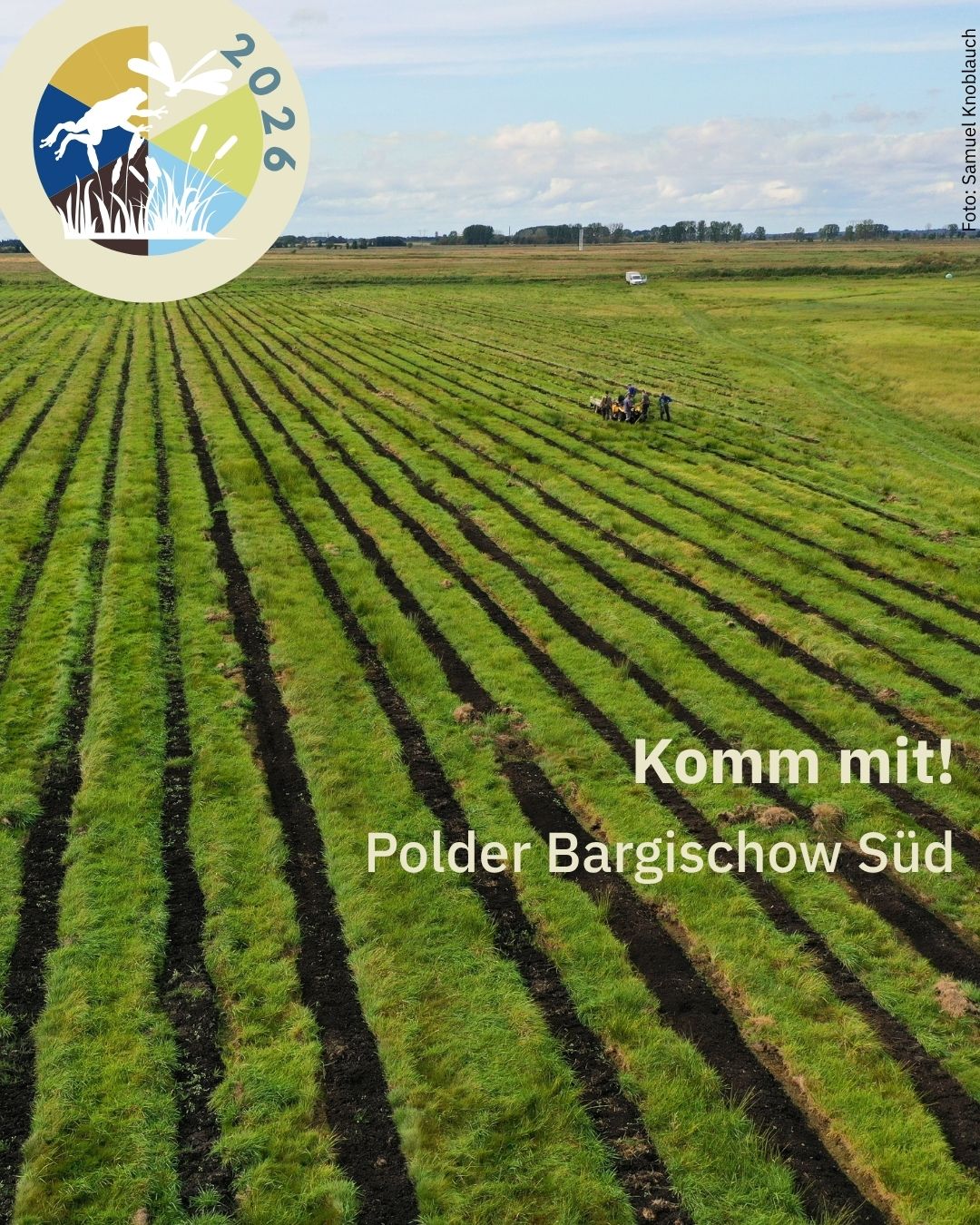
Excursion to the Bargischow Polderser
11/04/2026 The ‘A Year in Peatlands’ excursion series explores different peatland sites each month – ranging from near-natural areas to those under active use, as well as degraded and rewetted sites. On-site experts provide insights into biodiversity, land-use history, climate protection and restoration.
The next excursion takes place on 25th April 2026 from 10:00 to 12:30 at the Bargischow South Polder. The meeting point is at the pumping station in Bargischow. The route covers approximately four kilometres on foot along roads and gravel paths.
On site, the wet management of a rewetted fen with active water management will be presented. The aim is to demonstrate that site-specific use of peatlands is compatible with the requirements of bird, nature and climate protection and can also be implemented on a large scale.
The excursion will be led by Anke Nordt (University of Greifswald). Participation is free of charge and open to all interested parties. Weatherproof clothing and sturdy footwear are recommended.
Further information is available online: A Year in Peatlands